Four volumes of peer-reviewed theological scholarship.
Join the next generation of theological scholars.
Meet the minds behind the Warren Foundation.
Publish your research in our peer-reviewed journal.
Help keep rigorous theology free and accessible.
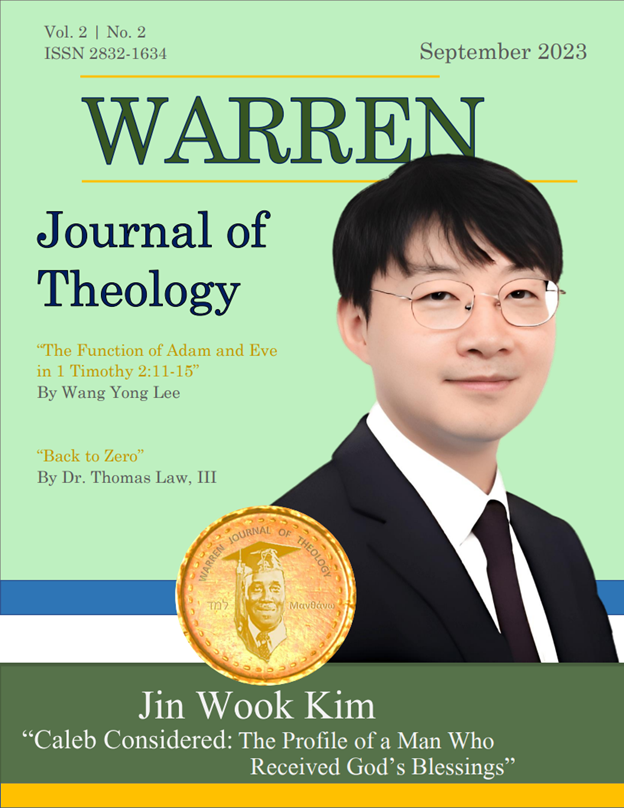
Volume 2 · Issue 2
Sept. 2023
3 articles
Read the full issue as a flipbook
Create a free account or sign in to read the complete issue.
This paper investigates why Paul appeals to the narrative of Adam and Eve in 1 Timothy 2:13–14 as grounds for his instructions regarding women in the Ephesian church. Through linguistic analysis of the key Greek terms πρῶτος ('first') and πλάσσω ('to form'), examination of Genesis 2–3, and engagement with Second Temple Jewish literature, the author argues that Paul's use of Adam and Eve is grounded in both their historical reality and their archetypal significance for all humanity. Adam's temporal and functional priority in creation, and Eve's deception in the fall, are shown to provide the theological rationale for the created order Paul invokes in the context of congregational worship—an order with permanent implications for the life of the church.
Using the Swiss watch industry's collapse as a metaphor for paradigm shift, this article argues that the Western church is at a 'hinge of history' requiring a return to New Testament foundations. The author identifies four key correctives: (1) moving from a 'Come and Hear' to a 'Go and Tell' posture, as modeled by Jesus and the early church; (2) replacing apologetics-driven programs with Spirit-led prayer and discernment; (3) starting evangelism where people actually are rather than where we wish them to be; and (4) shifting from an individualistic to a group-relational model of ministry. Together these shifts call the church toward an incarnational, go-to-them approach that reflects the relational DNA of the New Testament.
This paper argues that the Pentateuch contains a coherent, unified message: God prepared a place of blessing for humankind, humanity forfeited it through disobedience, God initiated a way back, and those who participate in God's blessings do so by faith. The paper tests this message against the narrative of Caleb in Numbers 13–14, demonstrating that Caleb's direct speeches and God's own description of him portray a man of wholehearted trust and obedience—contrasting sharply with the rebellious wilderness generation and with Moses himself, who did not enter the land. Caleb's story thus serves as a compelling case study in the Pentateuch's theology of faith-based participation in divine blessing.