Four volumes of peer-reviewed theological scholarship.
Join the next generation of theological scholars.
Meet the minds behind the Warren Foundation.
Publish your research in our peer-reviewed journal.
Help keep rigorous theology free and accessible.
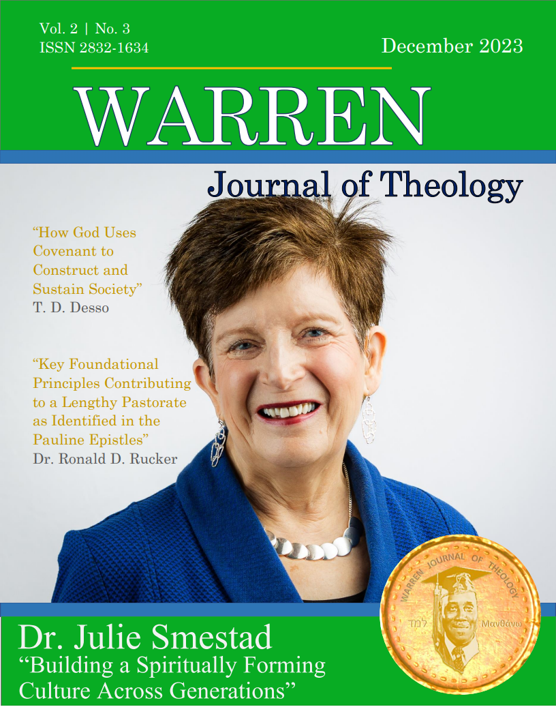
Volume 2 · Issue 3
Dec. 2023
3 articles
Read the full issue as a flipbook
Create a free account or sign in to read the complete issue.
With American churches losing approximately one million young people annually and 64 percent of Millennials raised in the church having dropped out, this article presents qualitative case-study research on how traditional churches can make changes to spiritually form Millennials while retaining older generations. The author's doctoral research identified that successful churches build common community identity through three practices: (1) fostering cross-generational relationships, (2) valuing Millennials and their contributions, and (3) creating intergenerational learning experiences. Drawing on case studies of Eastbrook Church and Blackhawk Church, the article argues that a humble, relational, and mission-focused church culture—rather than organizational strategy alone—is the key to discipling all generations for Christ.
With approximately 1,500 pastors leaving ministry monthly and the average pastoral tenure in Southern Baptist churches standing at just 4.6 years, this paper investigates the key foundational principles that contribute to a lengthy pastorate. Drawing on the example of the Apostle Paul in the Pauline Epistles, the author identifies five essential principles: spiritual maturity, understanding the call of God, prayer, leadership, and teaching the Word. The paper argues that the condition of a pastor's heart—not merely skill or strategy—is the decisive factor in long-term effectiveness, and that a tenured pastor who cultivates these principles will be equipped to stay the course and build a triumphant, fruitful ministry.
This paper explores five ways that divine covenant functions in the establishment and preservation of what the author terms 'divine covenantal society'—any society that is in covenant with God. The five functionalities examined are: covenant as mandate, agreement, promise, revelatory pedagogy, and point of reference for identity. These paradigms are traced through four covenants—Adamic, Noahic, Abrahamic, and Mosaic—drawing on the creation account and primeval history of Genesis 1–12 as interpreted through the lens of Deuteronomy 32 and Acts 17. The paper argues that divine covenantal society is fundamentally distinguished from secular society by its identity in God, its shared promise, and its eschatological orientation toward the inclusion of all nations.