Warren Journal of Theology
WarrenJournal of Theology
Back to Archive
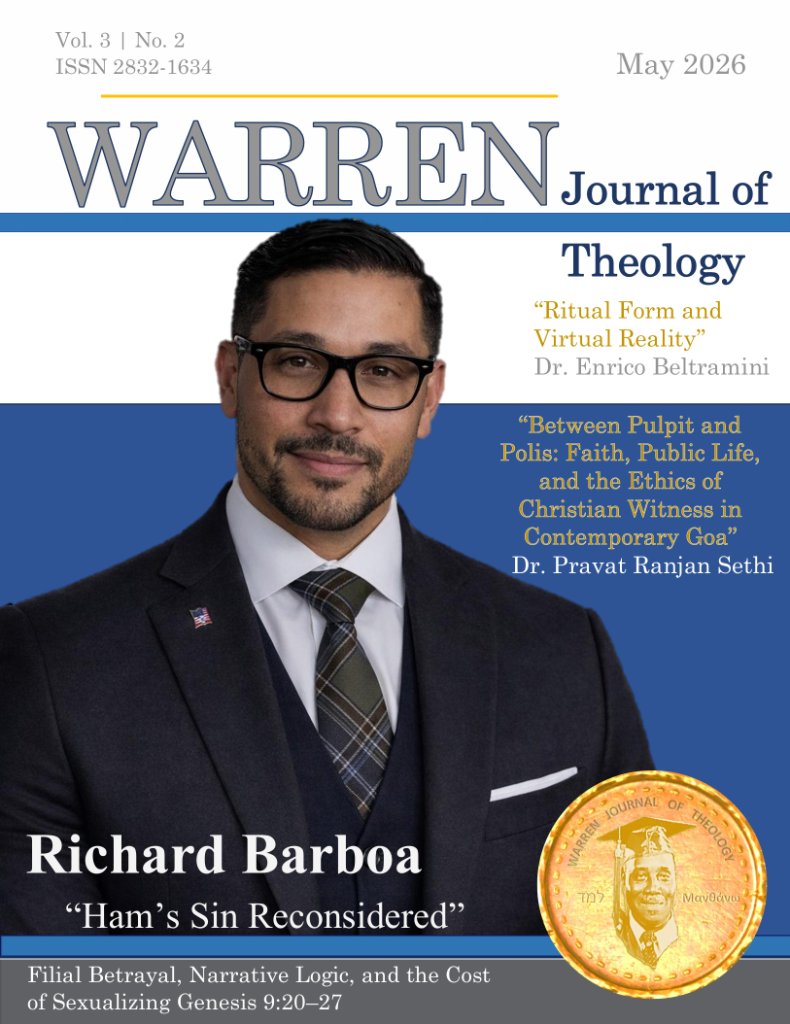
May 2026

Volume 3 · Issue 2

Warren Journal of Theology

May 2026

3 articles

political theology

Between Pulpit and Polis: Faith, Public Life, and the Ethics of Christian Witness in Contemporary Goa

Pravat Ranjan Sethi

This paper examines the relationship between faith and public life in contemporary Goa, situating Christian theological reflection within a historically layered, postcolonial, and plural socio-political context. Goa offers a unique site where ecclesial traditions, colonial inheritances, and modern democratic practices intersect, shaping distinctive forms of Christian public engagement. Drawing on scriptural hermeneutics, ecumenical theology, and lived practices of the church, the study interrogates how faith communities negotiate questions of justice, secularism, identity, and civic responsibility. It further explores the tension between orthodoxy and contextual responsiveness, suggesting that faithful Christian witness must move beyond doctrinal preservation toward transformative participation in public life. By bridging academic theology and ecclesial praxis, the paper contributes to broader global conversations on faith in the public sphere, proposing Goa as a microcosm for reimagining ethical Christian engagement in diverse societies.

practical theology

Ritual Form and Virtual Reality

Enrico Beltramini

The central claim of this study is that virtual reality (VR) is not a suitable medium for ensuring the validity of liturgical rites. While this conclusion is not in itself novel, the reasoning offered in support of it is. The article examines two dominant ways of conceptualizing VR: as a space and as an interface. When understood as a space, VR fails to meet the requirements of sacramental ontology and cannot enable the ontological transformation through which divine presence constitutes space as sacred. When reconceived as an interface, the ontological objection can be set aside, but a more fundamental difficulty remains: the impossibility of sustaining ritual form. Ritual form presupposes a unified, embodied, and ecclesial enactment of a received rite, whereas VR structures participation as mediated and parallel experiences rather than as a single liturgical action. Thus, the article concludes that, whether conceived as space or interface, VR cannot provide the conditions required for the valid enactment of liturgical rites.

biblical studies

Ham's Sin Reconsidered: Filial Betrayal, Narrative Logic, and the Cost of Sexualizing Genesis 9:20–27

Richard Barboa

This article reexamines Genesis 9:20–27 and argues against interpreting Ham's offense as a sexual violation. Through close analysis of the text's grammar and narrative structure, it shows that the passage emphasizes a moral contrast between exposure and covering, not sexual transgression. Ham's sin is best understood as filial betrayal—publicizing his father's shame—while Shem and Japheth model honor by protecting it. Situating this reading within the broader canon, the study highlights filial honor as a central covenantal norm. It critiques sexualized interpretations for imposing later legal categories, particularly from Leviticus, onto the narrative without textual warrant. Finally, it demonstrates how such readings have historically contributed to racialized misuse of the passage. The article concludes that Genesis 9 is best read within an honor–shame framework, where the gravity of Ham's act lies in violating a sacred familial trust rather than in any implied sexual act.

Warren Journal of TheologyWarren Theological Foundation

Providing perspective. A religious nonprofit dedicated to the dissemination of scholarly ideas, research, and concepts from Christian-theological studies.

Print ISSN: 2832-1634 · Online ISSN: 2832-1642

Contact

tddesso@warrentheology.org

warrentheology.org

Connecting Theology Podcast
© 2026 Warren Theological Foundation. All rights reserved.