Four volumes of peer-reviewed theological scholarship.
Join the next generation of theological scholars.
Meet the minds behind the Warren Foundation.
Publish your research in our peer-reviewed journal.
Help keep rigorous theology free and accessible.
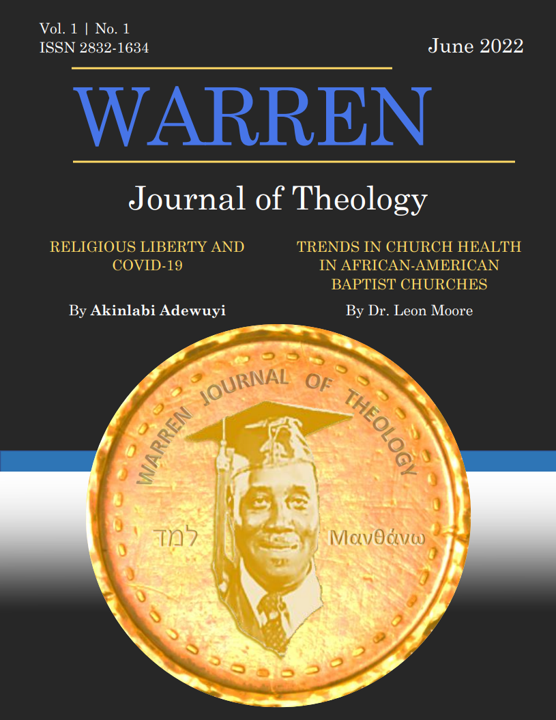
Volume 1 · Issue 1
June 2022
4 articles
Read the full issue as a flipbook
Create a free account or sign in to read the complete issue.
This paper argues that African culture—despite attempts by some scholars to deny its survival through the Trans-Atlantic slave trade—was the pre-eminent driving force behind the success of American revivalism in both the First Great Awakening (1730–1760) and the Second Great Awakening (1800–1830). Drawing on the work of Herskovits, DuBois, Sobel, and others, the author demonstrates that African cultural elements including ring dancing, shouting, folk preaching, and the call-and-response oratorical tradition survived slavery and were subsequently adopted by influential white preachers such as George Whitefield, Francis Asbury, and Devereux Jarrett. The paper traces this cultural transmission through figures like Harry Hoosier and Henry Evans, arguing that American Christianity—and indeed American popular culture—would not exist in its present form without the profound and underacknowledged contribution of African and African-American culture.
This article surveys the state of church health in African-American Baptist churches, drawing on LifeWay Research data, Pew Research findings, and the author's own 2018 church health perception survey of 113 participants in African-American Southern Baptist churches. The data reveals that AABC are experiencing growth, plateau, and decline patterns similar to the broader SBC, with 41% declining and 24.6% plateauing according to LifeWay's five-year metrics. Contributing factors identified include youth departures, insufficient discipleship and evangelism, transfer growth vs. conversion growth, and the social pressures facing African-American families. The author calls for ongoing strategic church assessments and greater scholarly attention to this underresearched field as essential to sustaining healthy, kingdom-advancing congregations.
This study investigates why monarchy—more than any other form of government—commands the attention of creative literature, particularly within the British literary canon. Examining eight canonical works including the Arthurian legend, Paradise Lost, The Canterbury Tales, and The Faerie Queene, the paper identifies recurring themes of divine appointment, Christian community, perpetuity of government, and the sacrificial burdens of kingship. The author argues that these literary glorifications of divine monarchy may reflect a deep, subconscious human longing for the eternal Kingdom of God, and that the ideals embedded in British monarchial literature—bloodline legitimacy, peace-through-one, and community over individualism—carry significant implications for political theology and our understanding of eschatological governance.
This paper examines the constitutional and biblical dimensions of Grace Community Church's (GCC) decision to defy California's COVID-19 restrictions on in-person worship. While affirming that GCC's constitutional position was vindicated by the Supreme Court—which struck down California's regulations as neither neutral nor generally applicable under the Free Exercise Clause—the paper argues that GCC's stance was nevertheless biblically deficient. Drawing on the Church's biblical mandate to love neighbors (Phil. 2:3-4), historical examples of churches cooperating with government during the 1918 Spanish flu pandemic, and the availability of alternative worship models adopted by other congregations, the paper concludes that GCC failed to balance its constitutional rights with its biblical responsibilities toward the community.