
Warren Journal of Theology
WarrenJournal of Theology

WARRENJournal of Theology

A quarterly publication of the Warren Theological Foundation — advancing scholarly theological conversation where the academy and the church meet.
Our Mission

Where Academy Meets Church

The Warren Theological Foundation is a religious nonprofit dedicated to the dissemination of scholarly ideas, research, and concepts from Christian-theological studies and conversations. Content is shared through our journal, panel discussions, workshops, seminars, and lectures.

Scholarly Rigor

Peer-reviewed theological research published quarterly, addressing topics from biblical studies to political theology.

Ecumenical Vision

We affirm that theological inquiry should be ethnically diverse and ecumenical — bridging the academy and the church.

Orthodox & Bold

We affirm the divinity of Jesus and the trustworthiness of Scripture while fearlessly addressing the most pressing topics.

From Our Pages

Recent Articles

Vol. 3 · No. 2

Between Pulpit and Polis: Faith, Public Life, and the Ethics of Christian Witness in Contemporary Goa

Pravat Ranjan Sethi

This paper examines the relationship between faith and public life in contemporary Goa, situating Christian theological reflection within a historically layered, postcolonial, and plural socio-political context. Goa offers a unique site where ecclesial traditions, colonial inheritances, and modern democratic practices intersect, shaping distinctive forms of Christian public engagement. Drawing on scriptural hermeneutics, ecumenical theology, and lived practices of the church, the study interrogates how faith communities negotiate questions of justice, secularism, identity, and civic responsibility. It further explores the tension between orthodoxy and contextual responsiveness, suggesting that faithful Christian witness must move beyond doctrinal preservation toward transformative participation in public life. By bridging academic theology and ecclesial praxis, the paper contributes to broader global conversations on faith in the public sphere, proposing Goa as a microcosm for reimagining ethical Christian engagement in diverse societies.

Read Article
Vol. 3 · No. 2

Ritual Form and Virtual Reality

Enrico Beltramini

The central claim of this study is that virtual reality (VR) is not a suitable medium for ensuring the validity of liturgical rites. While this conclusion is not in itself novel, the reasoning offered in support of it is. The article examines two dominant ways of conceptualizing VR: as a space and as an interface. When understood as a space, VR fails to meet the requirements of sacramental ontology and cannot enable the ontological transformation through which divine presence constitutes space as sacred. When reconceived as an interface, the ontological objection can be set aside, but a more fundamental difficulty remains: the impossibility of sustaining ritual form. Ritual form presupposes a unified, embodied, and ecclesial enactment of a received rite, whereas VR structures participation as mediated and parallel experiences rather than as a single liturgical action. Thus, the article concludes that, whether conceived as space or interface, VR cannot provide the conditions required for the valid enactment of liturgical rites.

Read Article
Vol. 3 · No. 2

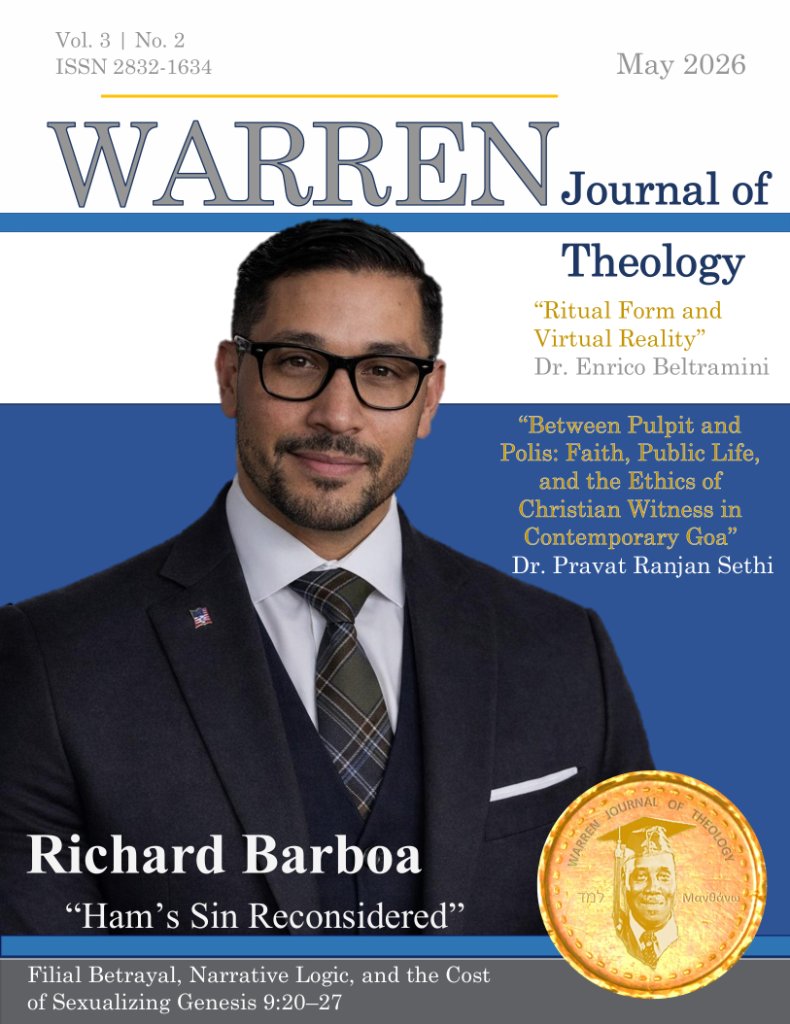
Ham's Sin Reconsidered: Filial Betrayal, Narrative Logic, and the Cost of Sexualizing Genesis 9:20–27

Richard Barboa

This article reexamines Genesis 9:20–27 and argues against interpreting Ham's offense as a sexual violation. Through close analysis of the text's grammar and narrative structure, it shows that the passage emphasizes a moral contrast between exposure and covering, not sexual transgression. Ham's sin is best understood as filial betrayal—publicizing his father's shame—while Shem and Japheth model honor by protecting it. Situating this reading within the broader canon, the study highlights filial honor as a central covenantal norm. It critiques sexualized interpretations for imposing later legal categories, particularly from Leviticus, onto the narrative without textual warrant. Finally, it demonstrates how such readings have historically contributed to racialized misuse of the passage. The article concludes that Genesis 9 is best read within an honor–shame framework, where the gravity of Ham's act lies in violating a sacred familial trust rather than in any implied sexual act.

Read Article
Vol. 2 · No. 1

The Preacher and the Terminator: How AI Impacts the Preparation of Sermons

Dr. Michael O. Oyedokun, II

This article explores the impact of artificial intelligence—specifically Chat GPT—on the hermeneutical and homiletical process of sermon preparation. The author acknowledges both the potential value of AI as a research and language tool for preachers and its significant risks: fostering intellectual laziness, enabling plagiarism, and replacing the Spirit-directed authenticity that is essential to genuine proclamation. Drawing on 20 years of preaching experience and a doctorate in Advanced Expository Preaching, the author argues that while technology may supplement the preacher's craft, no AI can substitute for the divine voice that speaks through the preacher, and that the trumpet of the Gospel must retain its distinctive sound.

Read Article
Vol. 2 · No. 1

Thinking Biblically about Eclecticism

Dr. Joseph Ellzey, Jr.

This paper examines the eclectic method of textual criticism as applied to Old and New Testament manuscripts, arguing that reasoned eclecticism is superior to the majority text method for determining the best reading of Scripture. The author surveys the necessity, definition, and complexities of eclecticism, evaluates external and internal evidence, and demonstrates how the eclectic method—unlike the majority text method—accounts for textually insecure passages and enables scholars to reconstruct 97–99% of the original New Testament. The paper concludes that the consistent, literal, grammatical, historical hermeneutical principle must accompany textual criticism to guard against eisegesis and to ensure that doctrine is built only on textually secure passages.

Read Article
Vol. 1 · No. 2

Christian Response to the Jehovah Witnesses Rejection of the Trinity

Dr. Ronald D. Rucker

This essay provides an introductory survey of the Jehovah's Witnesses' rejection of the doctrine of the Trinity, arguing that their theological positions are a modern continuation of fourth-century Arianism. The paper traces the origins of the Arian controversy from Arius of Alexandria in 319 A.D. through the Council of Nicaea (325 A.D.), then examines two primary Jehovah's Witnesses objections to the Trinity: that the term does not appear in Scripture, and that the doctrine is inherently confusing and therefore not of God. Drawing on biblical texts and comparative analysis, the author refutes both objections and demonstrates that the Watchtower Bible and Tract Society's Christology closely mirrors the Arian heresy condemned at Nicaea. The essay concludes with a call for Jehovah's Witnesses to abandon the Watchtower's doctrinal framework in favor of Scripture alone.

Read Article

Start Reading Today

Create a free account to access our full archive of theological scholarship. Join a growing community of pastors, seminarians, and scholars.

Free access to all published articles

Bridgeway App

Get the app for a better experience

Download
Warren Journal of TheologyWarren Theological Foundation

Providing perspective. A religious nonprofit dedicated to the dissemination of scholarly ideas, research, and concepts from Christian-theological studies.

Print ISSN: 2832-1634 · Online ISSN: 2832-1642

Contact

tddesso@warrentheology.org

warrentheology.org

Connecting Theology Podcast
© 2026 Warren Theological Foundation. All rights reserved.